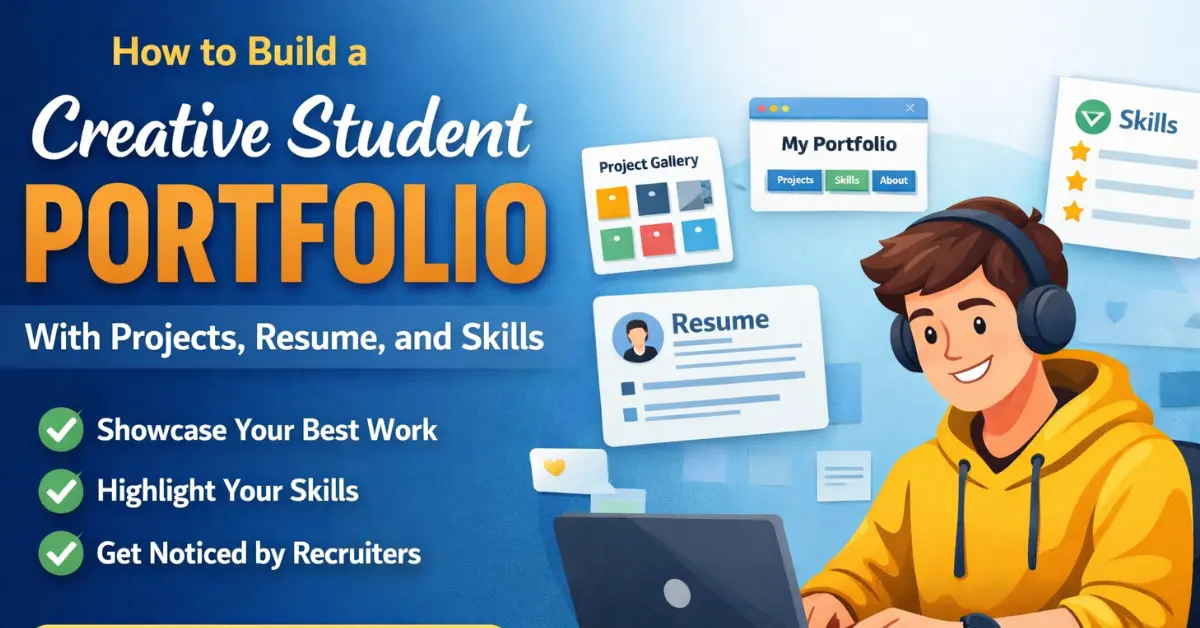
A student portfolio is no longer optional. Recruiters, colleges, and internship panels expect proof. Marks alone do not show your ability. A strong portfolio shows your thinking, effort, and skills in action.
This guide explains how you build a creative student portfolio from scratch. You will learn how to choose projects, write resumes, highlight skills, and present everything in a clean way. The goal is simple. Help you stand out.
Students often search for student portfolio examples before starting. A creative portfolio for students does not need expensive tools. It needs clarity, proof of work, and skills linked to projects. Whether you are building a portfolio for college students, a fresher job application, or internships, the structure remains the same. Focus on projects, a clean student resume with projects, and skills you can explain. An online student portfolio works best because it stays accessible and searchable.
Career Guidance Job-Ready Skills Post Pandemic for Indian Youth

What Is a Creative Student Portfolio
A creative student portfolio is a collection of your best work. It shows what you have learned and how you apply it.
Your portfolio can include:
- Academic projects
- Personal projects
- Internships or training work
- Skills and certifications
- A short resume
- Achievements and activities
Students from every stream need portfolios now.
Examples:
- Engineering students show coding projects or models
- Commerce students show case studies or analysis
- Arts students show designs, writing, or media work
- School students show competitions, experiments, and hobbies
Why a Student Portfolio Matters in 2026
Competition is high. Degrees look similar on paper. A portfolio gives you an edge.
Real benefits:
- Recruiters scan portfolios before interviews
- Colleges use portfolios for admissions and scholarships
- Freelance work depends on portfolio quality
- Internships shortlist students using projects, not marks
A LinkedIn study showed that candidates with work samples get more profile views than those with resumes only. Your portfolio works like proof.
Step 1: Decide the Goal of Your Portfolio
Start with clarity. Ask yourself one question.
What do you want this portfolio to do?
Common goals:
- Internship selection
- Job placement
- College admission
- Freelancing
- Skill showcase
Your goal decides everything. Projects, skills, and writing style depend on it.
Example:
If your goal is a tech internship, focus on:
- Coding projects
- GitHub links
- Problem-solving skills
If your goal is media or design:
- Visual work
- Process explanation
- Tools you use
Do not mix everything. One clear direction works best.
Step 2: Choose the Right Projects
Projects are the heart of a creative student portfolio. Quality matters more than quantity.
Pick 5 to 8 strong projects.
Good project types include:
- College assignments with real output
- Personal passion projects
- Online course projects
- Internship tasks
- Group projects where your role is clear
For each project, explain three things.
- Problem
- Approach
- Outcome
Example:
Project title: College Event Website
- Problem: No online platform for event registration
- Approach: Built a static website using HTML and CSS
- Outcome: 300 users registered successfully
This structure helps recruiters understand your thinking.
Avoid listing projects without explanation. Screenshots alone are not enough.
Step 3: Add Personal Projects to Stand Out
Personal projects show initiative. They matter more than compulsory college work.
Examples of personal projects:
- Blog or website
- YouTube channel
- Case study on a brand
- App prototype
- Research article
- Social media page growth project
Personal projects show:
- Curiosity
- Self-learning
- Discipline
If you do not have personal projects, start small.
Ideas:
- Rewrite a resume using Canva
- Build a simple calculator
- Write five blog posts
- Analyze a local business
Progress matters more than perfection.
Step 4: Highlight Skills the Right Way
Most students list skills without proof. That weakens the portfolio.
Instead, connect skills to projects.
Bad example:
Skills: Communication, teamwork, leadership
Good example:
- Communication: Presented project to 40 students
- Teamwork: Worked in a group of five for final-year project
- Leadership: Led event planning committee
Types of skills to include:
Technical skills:
- Programming languages
- Design tools
- Software
- Data tools
Soft skills:
- Communication
- Time management
- Problem solving
Transferable skills:
- Research
- Writing
- Analysis
Always show where you used the skill.
Step 5: Create a Simple Student Resume
Your resume and portfolio should match. Do not treat them as separate.
Your student resume should include:
- Basic details
- Education
- Projects
- Skills
- Achievements
Keep it to one page for freshers.
Tips for resume writing:
- Use short bullet points
- Start lines with action words
- Avoid long paragraphs
- Focus on outcomes
Example bullet:
- Designed a poster campaign that reached 2,000 students
Avoid fake experience. Honest portfolios perform better long term.
Step 6: Write a Strong Portfolio Introduction
The introduction sets the tone. Keep it short and personal.
Include:
- Who you are
- What you study
- What you are interested in
- What your portfolio shows
Example:
“I am a final-year commerce student with interest in finance and data analysis. This portfolio highlights my academic projects, personal research, and skills developed through coursework and internships.”
This helps reviewers understand you in 10 seconds.
Step 7: Choose the Right Platform
Your portfolio must be easy to access.
Popular portfolio platforms:
- Personal website
- Google Drive folder
- Notion page
- GitHub for tech students
- Behance for design students
Best option for ranking and long-term use is a personal website.
Website benefits:
- Appears in Google search
- Looks professional
- Full control over content
If you use Drive or Notion, keep links clean and organized.
Step 8: Design Matters, Keep It Clean
Design does not mean fancy.
Good design rules:
- Simple fonts
- White background
- Clear headings
- Easy navigation
Avoid:
- Heavy animations
- Loud colors
- Long loading time
A recruiter spends less than two minutes on a portfolio. Make scanning easy.
Step 9: Add Achievements and Certifications
Achievements add credibility.
Include:
- Scholarships
- Competitions
- Olympiads
- Hackathons
- Certificates
For certificates:
- Mention issuing platform
- Mention skill learned
- Avoid listing irrelevant ones
Example:
- Google Data Analytics Certificate, learned Excel and SQL basics
Do not upload dozens of certificates. Select the best.
Step 10: Update and Improve Regularly
A portfolio is not a one-time task.
Update it when:
- You finish a project
- You learn a new skill
- You complete training
- You gain experience
Set a reminder every three months.
Small updates keep your portfolio fresh.
Step 11: Optimize for Search and Sharing
If you want your portfolio to rank or get noticed online, basic SEO helps.
Simple SEO tips:
- Use your name in page title
- Add keywords like student portfolio, creative portfolio
- Write short project descriptions
- Add alt text to images
Also share your portfolio:
- LinkedIn profile
- Resume link
- Email signature
Visibility increases chances.
Common Mistakes Students Make
Avoid these errors:
- Copying portfolio content from others
- Listing skills without proof
- Adding too many weak projects
- Ignoring grammar and spelling
- Making it too flashy
A clean, honest portfolio beats an overdesigned one.
Final Checklist Before You Share
Before sending your portfolio, check this list.
- All links work
- Projects are explained
- Resume matches portfolio
- No spelling errors
- Contact details are visible
Ask one friend or mentor to review it.
A second opinion helps.
Why a Creative Student Portfolio Changes Your Career Path
A portfolio builds confidence. You see your growth in one place.
It also changes how others see you.
You move from a student to a problem solver.
In a crowded market, proof matters. Your portfolio is that proof.
Start small. Build step by step. Keep improving.
That is how strong careers begin.
FAQs
What should a student portfolio include ?
A student portfolio should include an introduction, academic and personal projects, skills with proof, a short resume, achievements, and contact details.
How many projects should a student portfolio have ?
Five to eight strong projects are enough. Focus on quality, clarity, and outcomes instead of quantity.
Do school students need a portfolio ?
Yes. School students can include competitions, experiments, creative work, sports achievements, and hobby-based projects.
Is a portfolio better than a resume ?
A portfolio supports a resume. A resume lists information. A portfolio proves it with real work.
Which platform is best for a student portfolio ?
A personal website works best for long-term use. Google Drive, Notion, GitHub, and Behance also work based on your field.
CALL TO ACTION SECTION
Start with one project today. Write what you did and what you learned. Add one skill you used. Build slowly. Share your portfolio link on LinkedIn and in applications. Update it every three months. This habit creates opportunities faster than waiting for marks alone.
A creative student portfolio shows effort, skills, and growth in one place. Projects prove learning. A clean resume supports it. Skills gain value when linked to real work. Start small. Update often. Share confidently. In a competitive world, a strong student portfolio opens doors faster than marks alone.
Impact of Digital & Remote Learning on Students’ Mental Health (challenges + solutions)